



What Is a Tender in Business? A Practical Guide for Australian SMEs
What is tender in business? Discover how Australian SMEs can win valuable government contracts by mastering the official tender process from start to finish.
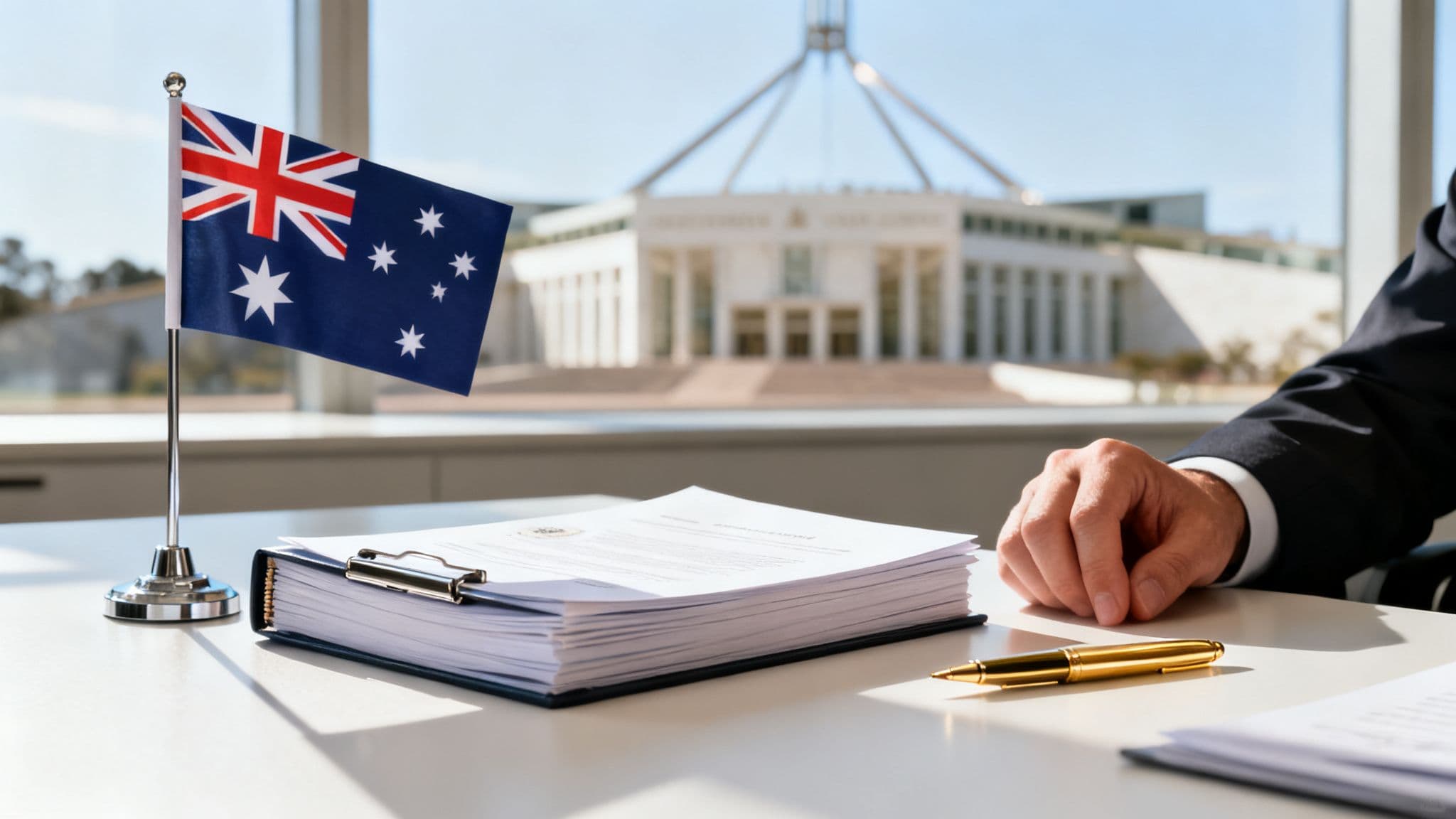
Ever wondered how your business can tap into the $70+ billion the Australian Government spends on procurement each year? The answer lies in mastering the government tendering process.
So, what exactly is a tender?
Think of it as a formal, structured job interview for your business. When a government agency needs to buy goods or services, they can’t just pick their favourite supplier. They run a tender—a formal process where organisations submit competitive bids to win a contract, especially for high-value work. This guide will explain everything an Australian SME needs to know.
Your Introduction to Government Tenders in Australia
For many Australian small and medium-sized enterprises (SMEs), the world of government procurement can feel like a members-only club, full of complex documents and confusing jargon. But once you understand what a tender actually is, the whole process opens up and reveals a massive opportunity for growth.

Unlike a simple quote, which often just focuses on price, a formal tender response requires you to prove everything—your capability, your experience, and your overall value. Australian Government agencies rely on this rigorous system to ensure fairness, transparency, and achieve the best possible "value for money" for taxpayers.
This structured approach is designed to create a level playing field, giving businesses of all sizes a fair shot at winning lucrative contracts. The scale of this market is immense, with over 80,000 contracts awarded annually through the federal AusTender platform alone.
Why Government Tenders Matter for Your SME
Winning government tenders is more than just another sales activity; it's a strategic move. A government contract can secure long-term, reliable revenue for your business, which is a game-changer for stability and growth. Success here proves your company is professional, reliable, and can meet the highest standards.
By learning to navigate the system, you position your organisation as a trusted government supplier. Our comprehensive guide on winning Australian government tenders is a great place to start that journey.
In this guide, we'll break down the essential concepts, from the different types of tenders you'll encounter to the step-by-step lifecycle of a bid. By the end, you'll see the Australian tendering landscape not as an intimidating challenge, but as a clear pathway to significant growth for your business.
To get started, here’s a quick rundown of the key terms you’ll need to know.
Tender at a Glance: Key Concepts
This table breaks down the core concepts you'll encounter in the tendering process, making the jargon a lot less intimidating.
Term
What It Means for Your Business
RFT/RFQ/RFP
The document the government issues. It contains all the rules, requirements, and questions you need to answer. Your whole tender response is built around this.
Evaluation Criteria
The scorecard the government uses to judge your tender response. You need to provide strong, evidence-based answers for each criterion to score points.
Value for Money
This isn't just about being the cheapest. It's the government's way of weighing your price against your quality, experience, and ability to deliver.
Mandatory Requirements
Following all the rules in the tender document. This is non-negotiable—one mistake and your tender response could be rejected before it's even read.
Addendum
An update or clarification to the tender documents after they've been released. You must acknowledge and incorporate these into your final tender response.
Understanding these terms is the first step. They form the foundation of every government tender you'll ever work on.
The Different Types of Tender Processes Explained
Not all government tenders are created equal, and knowing the difference is your first strategic advantage. When a government agency needs to buy something, they don't just use one single method. Understanding their playbook helps you focus your energy on the government tenders you’re most likely to win.
In Australia, government procurement generally falls into three main categories. Each comes with its own set of rules, pros, and cons, especially for small and medium businesses.
Open Tenders
This is the most common and transparent process you'll come across. An Open Tender is exactly what it sounds like: a public invitation for any interested business to throw their hat in the ring. You'll see these advertised widely on portals like the federal government's AusTender and state-based equivalents.
For any SME, this is often the best front door into the world of government contracting.
Pros: It creates a level playing field where any business that meets the minimum requirements can compete. You don’t need a pre-existing relationship with the agency to get a look-in.
Cons: Because they’re open to everyone, the competition can be absolutely fierce. You’ll be up against a lot of other businesses, including the big, experienced players.
Selective Tenders
A Selective Tender process is much more restricted. Government agencies use this when they only want to invite bids from a pre-approved list of suppliers. Getting on this list usually means going through a separate pre-qualification process, often known as joining a "panel" or a "multi-use list."
This approach is common for ongoing needs like IT support, legal advice, or construction work. The initial application to join a panel can be demanding, but once you're on, you get access to a pipeline of exclusive opportunities with far less competition.
To get a feel for the paperwork involved in these processes, it's worth understanding the structure of a Request for Tender (RFT).
Limited Tenders
Finally, a Limited Tender (sometimes called direct sourcing) is the most restrictive of all. This is where a government agency approaches one or more specific suppliers directly, with no public advertisement.
Under the Commonwealth Procurement Rules, this is only allowed in very specific situations. Think extreme urgency, like a natural disaster, or when only one supplier in the world can provide the required goods due to patents or highly specialised skills.
For most SMEs, these opportunities are rare unless you offer a truly unique product or service that government is already aware of. Your best bet is to focus on mastering Open and Selective tendering to build your track record and reputation.
Navigating The Government Tender Lifecycle Step by Step
Winning a government contract isn't a one-off task; it's a journey. Understanding the distinct stages of the tender lifecycle is the key to managing your time, focusing your resources, and crafting a response that actually wins. Get this right, and you'll stop wasting precious hours on government tenders you were never going to win.
This process starts long before you write a single word of your response and continues well after you get the final decision. Let’s walk through the entire lifecycle, from finding the right opportunity to learning from the outcome.
Stage 1: Discovery and The Go/No-Go Decision
First things first, you have to find the opportunities. This hunt begins on official government portals like the federal AusTender or various state-based platforms. But just finding a tender is the easy part. The most critical step in this entire stage is the Go/No-Go decision.
This is your internal gut check. It’s where you honestly assess if bidding is a smart move for your business. Ask yourself:
Do we meet all the mandatory requirements?
Do we have the time and resources to prepare a high-quality tender response?
Does this contract genuinely align with our long-term business goals?
Rushing this decision is one of the biggest mistakes SMEs make. It leads directly to wasted time, money, and morale on bids that were a non-starter from the beginning.

This process flow shows how opportunities can range from open competitions to more targeted engagements, which is something you'll identify during this discovery phase.
Stage 2: Response Preparation and Submission
Once you've committed with a firm "Go," the real work begins. Response preparation is where you roll up your sleeves and dissect the Request for Tender (RFT) documents. Your goal is to map every single answer directly back to the evaluation criteria and find solid evidence to prove your claims.
Be prepared for a significant time investment. This is easily the most intensive phase, often taking between 40-80 hours of focused work. You’ll be writing compelling content, filling out all the required forms, and making sure your pricing is spot-on.
Submission is the final, non-negotiable step. This is a hard deadline. Lodging your response through the correct government portal, on time, is a mandatory requirement. A last-minute technical glitch or being even one minute late can get your entire tender response thrown out instantly.
Stage 3: Evaluation and Notification
After the deadline passes, the government agency kicks off its evaluation process. A panel of assessors will review every compliant bid against the criteria they published in the RFT. This is where all your hard work in the preparation stage either pays off or doesn't. During this period, don't be surprised if the agency reaches out to ask for clarification on specific points in your response.
Eventually, you'll get the notification—the outcome. But whether it's good news or bad, the lifecycle isn't quite over. The final, and arguably most important, step is the debrief. Always ask for feedback. The insights you gain are pure gold for improving future bids and truly understanding the complete procurement business process from the buyer's side.
Decoding Key Tender Documents and Acronyms
Opening a government tender for the first time can feel like trying to decipher a secret code. You're hit with dense legal text, complex requirements, and an alphabet soup of acronyms. It's easy to feel overwhelmed, but don't be. Once you understand the core components, it all starts to make sense.
Think of the tender document pack as the official rulebook for the competition. Every single winning tender response starts with a deep understanding of these rules. Getting this right isn't just a good idea—it's the non-negotiable first step to even being in the running.

Core Tender Documents You Must Know
While every tender has its unique quirks, most Australian government opportunities are built around a few key documents. Knowing what each one does helps you focus your time and energy where it truly counts.
Request for Tender (RFT): This is the main event. The RFT is the big-picture document that outlines exactly what the government agency needs, the rules of the game, and everything you must provide in your response. Treat it as your single source of truth for the entire tender response.
Conditions of Tender: This is the legal fine print. It details the non-negotiable rules of engagement, covering everything from deadlines and submission methods to confidentiality and conflict of interest policies. One slip-up here often leads to immediate disqualification.
Statement of Requirements (or Scope of Works): This is where they tell you what they actually want to buy. It gets into the nitty-gritty of the specific goods, services, or outcomes they expect, including technical specs, delivery timelines, and performance standards.
Response Forms/Schedules: These are the templates you must use. Government agencies provide these structured forms to make sure they receive information consistently, which makes it easier for them to compare bids apples-to-apples. Never, ever alter these forms—just fill them out precisely as instructed.
The Most Important Page: The Evaluation Criteria
If you only have time to read one part of the tender pack properly, make it the Evaluation Criteria. This is literally the scorecard the government's evaluation panel will use to grade your tender response against everyone else's.
Your entire tender response should be a direct answer to these criteria. It explains how you'll be scored on things like capability, experience, methodology, and price. Understanding this is crucial for learning how to address the government tender evaluation criteria effectively and maximise your score.
A classic mistake SMEs make is writing a generic sales pitch. They talk about how great their business is instead of providing specific, targeted evidence against each criterion. To win, you have to structure your entire tender response to make it painfully easy for the evaluators to tick their boxes and give you points. This strategic focus is what separates the winners from the also-rans.
Cracking the Code: Common Tender Acronyms
You'll quickly notice that government procurement is swimming in acronyms. Knowing them saves you time and prevents confusion. Here’s a quick reference guide to the most common ones you'll see in Australian tendering.
Common Tender Acronyms and What They Mean
Acronym
Full Name
What It Is
RFT
Request for Tender
The primary invitation for suppliers to submit a formal tender response for goods or services.
RFQ
Request for Quotation
A simpler request for pricing on specific, often lower-value, goods or services.
RFI
Request for Information
A market research tool used by government to gather information before a formal tender.
EOI
Expression of Interest
A preliminary stage to shortlist interested and capable suppliers before a full RFT.
ATM
Approach to Market
The official, overarching term used on AusTender for any public procurement opportunity.
SME
Small and Medium-sized Enterprise
Businesses defined by size, which are often encouraged to participate in government contracts.
VfM
Value for Money
The core principle of government procurement—not just the cheapest price, but the best outcome.
Getting comfortable with this language is the first step towards confidently navigating the tendering process. When you see an RFT or EOI, you'll know exactly what kind of opportunity it is and what's expected of you.
How Government Tenders Are Evaluated to Find a Winner
Ever wonder why some businesses win government contracts and others don't? It's rarely about being the cheapest. The entire process is designed around one core principle of Australian Government procurement: finding the best overall value for money. Let’s peel back the curtain and see how the evaluation process really works.
Government evaluation committees don't just glance at your price; they meticulously score your entire response against a set of criteria published right in the tender documents. This means your capability, your experience, your proposed solution, and your risk management plan are often just as important as your pricing schedule. The secret to writing a winning submission is understanding exactly how you're being judged.
Mandatory Requirements vs Weighted Criteria
The first hurdle in any evaluation is the compliance check. Think of this as a pass/fail gate. Tender documents list mandatory requirements, and if you miss even one, your tender response is out before it's even properly read. A missing signature, submitting five minutes late, or not holding a required certification can get your entire response disqualified.
Once you’ve cleared that initial check, the committee moves on to the weighted criteria. This is where you actually score points. Each criterion is assigned a percentage, showing you exactly what the agency cares about most.
A typical weighting might look like this:
Demonstrated Experience & Capability: 40%
Proposed Solution/Methodology: 30%
Price: 30%
Look closely. In this common scenario, a massive 70% of your total score has absolutely nothing to do with your price. Your job is to build a rock-solid case, using hard evidence and data, that proves you are the lowest-risk and highest-value choice for the government. The key is to structure your response to hit every single one of these criteria head-on.
Winning is about proving you are the best overall solution, not just the cheapest option. High-scoring responses provide specific evidence, case studies, and data that directly align with each evaluation criterion, making it easy for the panel to award maximum points.
And this is an environment where SMEs are thriving. Official statistics show that SMEs win approximately 25% of Commonwealth contracts by value, proving that by focusing on value and capability, smaller businesses can, and do, compete and win. If you want to dive into the numbers yourself, you can explore the government's procurement data.
How AI Gives Your SME a Competitive Edge in Tendering
Let's be honest: spending 40 to 80 hours preparing a single government tender response is a massive hurdle for most small and medium-sized businesses. It’s a huge time sink. This is where modern technology completely changes the game, finally allowing smaller, agile businesses to punch well above their weight and compete with the big players.
An AI platform like GovBid, built specifically for the Australian market, helps you get in the ring without the crippling overheads. It can turn a resource-draining chore into a powerful engine for growing your business.
Instantly Assess Tender Suitability
One of the biggest time-wasters in tendering? Chasing opportunities you have almost no chance of winning. AI-powered suitability scoring cuts right through the noise, instantly analysing a tender's requirements against your business profile and past performance.
This feature gives you a data-driven "Go/No-Go" recommendation in minutes, not days. By quickly weeding out mismatched bids, you save countless hours and can pour all your energy into the government tenders you are genuinely positioned to win.
Accelerate Your Tender Writing
Drafting high-quality, compliant answers that nail the evaluation criteria is easily the most time-consuming part of the whole process. Think of AI-assisted writing tools as your expert co-pilot, helping you generate clear, professional content in a fraction of the time.
This isn’t about replacing your expertise; it’s about amplifying it. AI helps you structure responses properly, ensures you’ve covered every single point in the requirements, and maintains a consistent, professional tone throughout your submission. You can see how this works in our detailed guide on AI tender writing in Australia.
Ensure Flawless Compliance
It’s a painful truth, but simple admin errors can get an otherwise brilliant tender response disqualified before a single word is even read. Automated compliance checks are your safety net. They scan your documents for common but fatal mistakes like missing signatures, incomplete forms, or unanswered mandatory questions.
This frees you up to focus on the important stuff—your strategy and proving your value—confident that a simple oversight won't derail all your hard work. For SMEs looking to get smarter with technology across the board, learning other tools can be a game-changer. You can discover more ways to handle data during the tendering process with resources like this Excel AI: A Practical Guide to Using Artificial Intelligence in Spreadsheets.
Your Top Questions About Business Tenders, Answered
Jumping into the world of government procurement can feel like learning a new language. If you're new to this space, you've probably got a few questions. Let's tackle some of the most common ones that businesses ask.
What's the Real Difference Between a Tender and a Quote?
This is a classic, and the distinction is crucial.
Think of a quote (often called a Request for Quotation or RFQ) as a quick price check. It’s used for simple, low-value purchases where the main thing the buyer cares about is the cost. "How much for 50 new laptops?" is a classic RFQ scenario.
A tender (or Request for Tender, RFT) is a different beast entirely. It’s a formal, structured process for complex, high-value projects. Here, the price is just one piece of the puzzle. The government needs to know you can actually deliver, so you'll have to prove your capability, showcase your experience, and explain how you'll manage risks. They're not just buying a product; they're looking for a reliable partner who offers the best overall value for money.
Can My Small Business Actually Win a Government Tender?
Absolutely. It's a common misconception that only the big players win these contracts.
The Australian Government isn't just open to working with SMEs; it actively encourages it through specific procurement targets. Official data consistently shows small and medium businesses win a huge slice of the federal contract pie.
Winning isn't about luck; it's about strategy. You need to:
Pick your battles. Go after opportunities where your unique skills are a perfect match for the government's needs.
Shout your value from the rooftops. Clearly explain what makes you the best choice, using evidence and case studies.
Nail the details. Submit a professional, polished tender response that ticks every single box and answers every question in the evaluation criteria.
How Much Does It Really Cost to Bid on a Tender?
The biggest cost isn't money—it's your time.
Putting together a solid tender response is a serious commitment, often taking 40-80 hours of your most senior people's time. If you decide to bring in a professional bid writer, you could be looking at anywhere from $5,000 to over $50,000 for a single submission.
This is exactly why smart businesses are turning to AI. A huge investment of time and money just isn't sustainable if you want to bid regularly. AI-powered platforms slash the internal hours needed to prepare a top-notch submission. It's also worth noting that integrating tools like AI lead generation tools can sharpen your SME's overall market strategy, giving you another layer of competitive advantage.
Ready to stop wasting time and start winning more government tenders? GovBid gives you the AI-powered tools to find the right tenders and write winning responses faster. Browse 1,000+ active government tenders at https://www.govbid.com.au.

Ready to Win More Government Tenders?
GovBid helps you find, analyse, and respond to Australian government tenders with AI-powered assistance. Start your free trial today.